Dr. Perkins and his staff are super friendly and easy to communicate with. Dr. Perkins is a perfectionist and worked tirelessly on adjusting my bite. He wants to make sure his clients are satisfied.
- Home
- »
- Fix a Weak Chin and Receding Jawline Without Surgery
DR. BOB PERKINS DDS
Fix a Weak Chin or Jawline in a Few Weeks Without Fillers or Surgery
Medically reviewed by Robert Perkins, DDS
In most adults, a weak chin is really a problem with the position of the jaw. The lower jaw sits too far back and pulls the chin with it, so the non-surgical fix is to move the jaw forward into its healthy position rather than padding the chin with filler or an implant. Dr. Bob Perkins does exactly that with the JawAlign method, in weeks, with no surgery and no drilling.
If you’ve ever studied your side profile in a photo and wondered why your nose looks too big or your neck looks soft, consider a possibility almost nobody gets told: The nose and the chin are usually fine. The jaw behind them is set back, and it can be moved.
What Is a Weak Chin?
A weak chin describes a lower face where the chin slopes backward instead of supporting the profile. Dentists call the underlying condition retrognathia, which means the lower jaw sits behind where it belongs. Plain words from here on: a set-back jaw.
A weak chin is usually a normal chin attached to a lower jaw that sits too far back. There is not a deficiency of the chin bone itself. True chin-bone deficiency exists, but it’s rare. Far more often the chin bone is a perfectly normal size, and the whole lower jaw sits behind its healthy position, dragging the chin and the neckline back with it.
That distinction matters because the two problems have completely different fixes. It also explains something surprising. A double chin is not the result of excess fat! Again, it is the position of the jaw itself that creates the appearance of sagging skin or excess fat. When the jaw sits back, loose tissue under the chin has nowhere to go. If you’ve dieted at yours and it hasn’t budged, the jaw may be the reason.
What are the signs of a weak chin or receding jawline? If your lower jaw sits too far back you might recognize some of these:
- A chin that slopes backward instead of supporting the profile
- A double chin that dieting hasn’t budged
- A softened jawline and neckline that keep blurring over time
- A rounded side profile that makes the nose look too big
- Corners of the mouth that fold inward, with creases settling in around the mouth
- Lip posture that has changed as the jaw sits farther back
- Crowded teeth from a bite that developed off course
- Airway strain and poor sleep
Why Do Chins Recede? It's Usually Not Genetics
A receding chin isn’t just the result of genetics. That surprises almost everyone, because we treat our faces as genetic hand-me-downs. The research says otherwise.
The face develops around function. How a child breathes, through the nose or through the mouth, and how the jaw and tongue are postured during the growth years largely determine how the jaws form.
As Dr. Perkins explains in his book, The Health Nexus, the face has a factory setting. Follow it and the jaws grow forward. Deviate from it, through mouth breathing or poor oral posture, and the result is the set-back jaw, weak chin, and crowded teeth that adults later treat as cosmetic flaws.
Dentists call a misaligned bite a malocclusion, and the striking thing is how rarely it comes down to genes. Research by Dr. Jerome Rose, cited in Dr. Perkins’ The Health Nexus, found that “95% of all malocclusions are acquired. Genetics plays a role in only 5%.”
These bite problems are everywhere, too. A worldwide review of bite alignment studies found roughly one person in five has a Class II bite, the pattern where the lower jaw sits behind the upper.
The payoff is simple. What was acquired can very often be repositioned. A jaw that drifted back during development was never fused in the wrong place, so it can be guided forward comfortably and without surgery. That is why a real non-surgical fix for a weak chin exists at all.
Proven Weak Chin Correction
In Weeks, Not Months
Without Implants, Fillers, or Surgery
How Can You Fix a Weak Chin Without Surgery?
You can fix a weak chin without surgery by repositioning the lower jaw itself, which is what the JawAlign method does in a matter of weeks. Every other non-surgical option, from fillers to contour makeup, changes how the chin looks without changing where the jaw sits. The table below compares the full menu.
| Treatment | What it changes | Fixes the cause? | Lasts | Downtime |
|---|---|---|---|---|
| Chin filler | Adds volume in front of the chin | No | About 6 to 12 months for most hyaluronic acid fillers | Minimal |
| Chin implant (surgical, shown for contrast) | Adds projection over the chin bone | No | Permanent device | Surgical recovery |
| Jaw exercises / mewing | Muscle tone, at most | No | Nothing measurable in adult bone | None |
| Makeup contouring | The shadow, not the chin | No | Until you wash your face | None |
| Braces or clear aligners | Tooth position only | No | Years, though relapse is common | 12 to 36 months in treatment |
| Jaw surgery | Jaw bone position | Yes | Permanent | 2 to 3 years total with orthodontics |
| JawAlign non-surgical jaw repositioning | Jaw position | Yes | Permanent restorations | None, completed in weeks |
For a very mild case, filler’s temporary projection may be enough. The catch, per the FDA’s dermal filler guidance, is that the body steadily absorbs it, so the result is a not in any way a lasting solution.
Chin implants sit in the table for contrast because they’re surgery, and the clinical literature treats them as changing the chin’s surface, instead of the jaw position.
Neither chin implants nor chin fillers will create the facial harmony that comes from actually moving the lower jaw. Without moving the lower jaw, the rest of your face including your nose and lips will still look unbalanced.
Jaw exercises and mewing have passionate fans online and divided providers. Dr. Perkins will say it plainly. Exercise cannot move bone in an adult.
Makeup contouring at least admits it’s an illusion.
Braces and clear aligners move teeth but can’t move the jaw, which is why so many adults finish orthodontics with straighter teeth and the same profile. If your bite is part of the picture, read about overbite correction without surgery.
Only two approaches change the position of the jaw itself: jaw surgery and non-surgical jaw repositioning. Fillers, implants, exercises, and makeup camouflage the chin without touching the cause.
Why Fillers and Implants Can't Fix a Jaw That's Set Back
Fillers and implants can’t fix a set-back jaw because they treat the chin as the problem, and the chin was never the problem. Filler adds volume in front of a jaw that still sits in the wrong place. An implant does the same with silicone. Meanwhile everything governed by jaw position stays put. The slope of the profile. The posture of the lips. The soft tissue under the chin. The line of the neck.
Camouflage does have its place. A well-placed filler can sharpen a mild case for a season, and nobody should pretend otherwise. But when the jaw is the cause, adding material in front of it is like propping a leaning fence with a garden gnome. Decorative, but structurally beside the point.
Patients feel the difference when the jaw itself moves. Di T., one of Dr. Perkins’ patients, said friends couldn’t tell what she’d done and guessed cosmetic surgery. In her words, “I had no idea that your whole face structure could be changed by changing your bite and realigning your jaw.” Results vary by patient, and her outcome reflects her individual case.
If the jaw is the cause, move the jaw.
Not sure which category your chin falls into? Schedule a consultation with Dr. Perkins before you waste time with a solution you’ll regret.
Fix Your Weak Chin
Naturally
Without Implants, Fillers, or Injections
The JawAlign Method: Moving the Jaw Forward Without Surgery
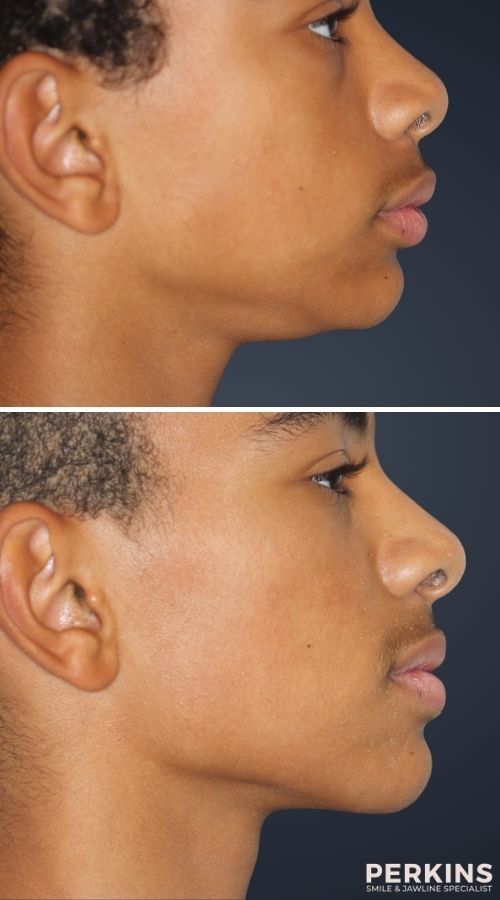
JawAlign is Dr. Perkins’ revolutionary non-surgical method for moving the lower jaw forward into its healthy position and holding it there permanently. No bone is cut and no healthy teeth are drilled down. Dr. Perkins developed it over 25+ years of repositioning jaws naturally for hundreds of patients, and it’s available only at his Malibu practice.
The part patients love most is the test drive. Before anything permanent happens, the JawAlign method lets you wear and test the new jaw position for two to three weeks, and the profile change is visible at the very first visit.
You confirm that the result looks right and feels right while everything is still reversible. No other approach to a weak chin, surgical or otherwise, lets you preview the outcome before committing.
The patient path looks like this.
Consultation. Dr. Perkins evaluates your bite and full facial structure to confirm the chin issue is a jaw position issue.
Trial phase. You wear the corrected jaw position for two to three weeks. The change in your profile shows immediately, and nothing is permanent yet.
Permanent restorations. Once you approve the result, the position is locked in with restorations built on the same philosophy as his no prep porcelain veneers, preserving healthy enamel instead of grinding it away.
Follow-up. A short visit to fine-tune comfort. No monthly adjustments, no food restrictions, no liquid diet, no recovery period.
What a Weak Chin Correction Looks Like
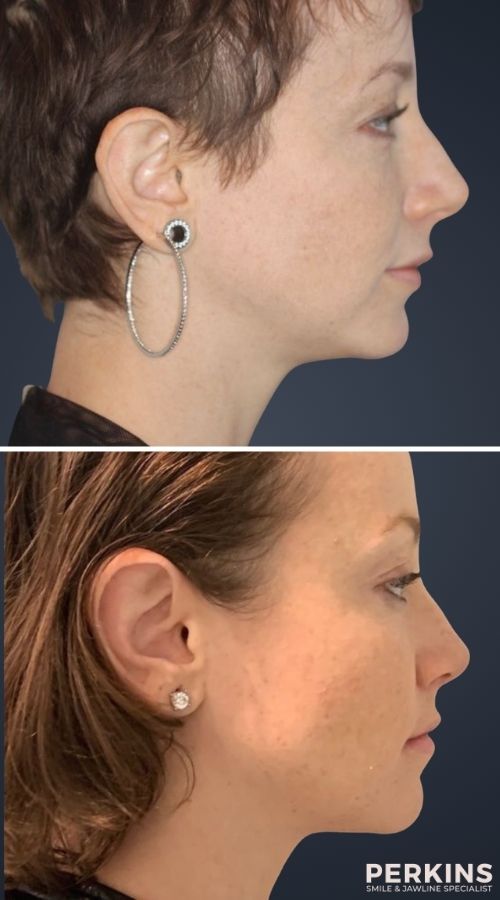
Correcting a weak chin changes the whole lower third of the face, and one of Dr. Perkins’ cases proves it. The patient came in with a jaw that sat well behind its healthy position and a soft double chin.
In about four weeks, her profile transformed. The soft tissue under her chin completely flattened out, and even her lip posture changed as the jaw came forward. Nothing was removed and nothing was injected. The structure underneath finally supported the tissue on top.
Other patients describe the same kind of shift. Brando Torres put it this way: “My face harmonized, jawline sharpened, airway expanded, TMJ healed… the way I look, talk, and even how I pronounce my words have all changed.”
Every case is different. Results vary by patient, and these outcomes are individual, not a promise of what treatment will do for you.
For an example of a patient case breakdown, see Priscilla’s collapsed bite case, where a collapsed bite and shortened face were corrected without surgery or drilling.
A Weak Chin Ages Your Whole Face
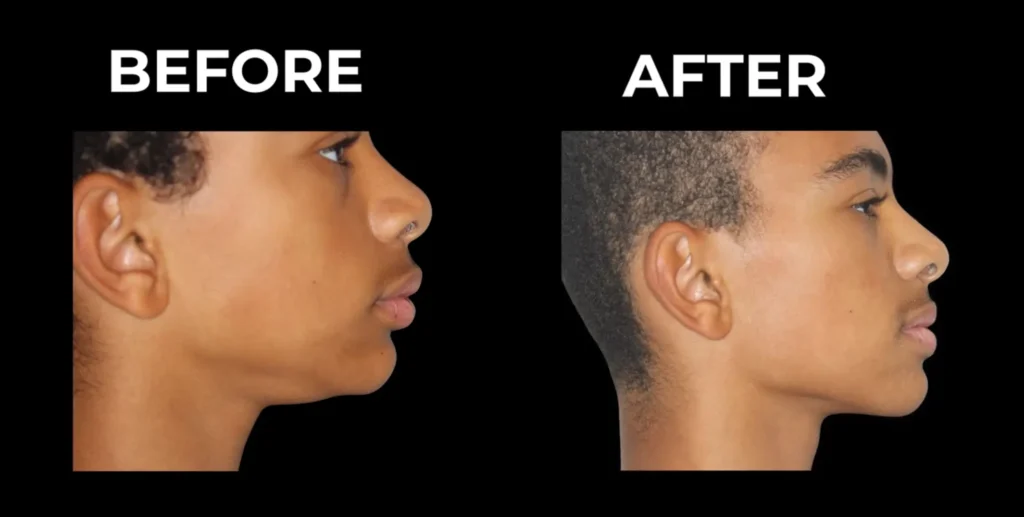
A weak chin doesn’t stay a chin issue. It ages the entire face, and Dr. Perkins devotes part of The Health Nexus to explaining why. Facial skin needs bone underneath it the way a tent needs poles. When the jaw sits too far back, the skin of the lower face loses that support, so it sags and creases years ahead of schedule.
The double chin deepens. The jawline blurs. The corners of the mouth fold inward. The neckline softens.
The hopeful part is that support can be restored. As Dr. Perkins explains in his book, moving the jaws and teeth forward, comfortably and non-surgically, gives the soft tissue its scaffolding back. Much of what people chase with face lifts and injectables sits downstream of jaw position.
Dr. Perkins has treated patients from their teens through their nineties, and some of the most dramatic transformations happen in patients in their 50s through 70s.
If you’ve been researching face lifts because your lower face keeps softening, book an evaluation with Dr. Perkins first. The jaw may be the real story.
Zachary Lichaa

I went into Dr. Perkins to fix my jaw due to a severe overbite. I came out of his office with a new smile and a reconstructed facial structure. Dr. Perkins truly cares about his patients and dedicates a lot of time and energy to make sure his patients are happy and looking great. I highly recommend giving Dr. Perkins a visit, you wont regret it!
Bradley S.
I really was looking for someone to address my profile and bite issues. I am so happy to have found someone who knew exactly how to give me the results I was looking for. I was so afraid of surgery and orthodontics made no sense with my condition. Grateful!
Tiffany Castillo
Dr.Perkins said a great job of changing my bite and giving me a much better profile.My body is so much more comfortable in my face looks really proportional now.Everything went great.He never had to drill on my teeth his a genius there is no one else that could do this for me thank you Dr.Perkins 😊
What Does It Cost Compared to Jaw Surgery?
Jaw surgery typically runs $20,000 to $50,000 out of pocket, and money is the smaller part of the price. It also means a liquid or soft diet for four to six weeks at minimum, and some patients report closer to a year. For anyone weighing jaw surgery alternatives, JawAlign asks a comparable investment and completes the repositioning in weeks, not years.
From the first orthodontic appointment to full healing, jaw surgery commonly takes two to three years. JawAlign repositions the jaw in a few weeks.
| Jaw surgery | JawAlign | |
|---|---|---|
| Total time | 2 to 3 years | A few weeks |
| Diet impact | Liquid or soft diet, 4 to 6+ weeks | None |
| Recovery | Bone healing up to a year | No recovery period |
| Reversible trial first | No | Yes, 2 to 3 weeks |
What you buy instead of an operating room is the trial phase surgery can never offer.
On insurance, the office is out-of-network with all providers, but the team submits claims for the functional components of treatment, and financing is available.
About Dr. Perkins
Dr. Bob Perkins has practiced dentistry for more than 30 years, with over two decades spent treating the face and the bite as one system. Trained at USC and an alumnus of the Las Vegas Institute for Advanced Dental Studies, he has spent 25+ years repositioning jaws non-surgically for hundreds of patients. He developed Facial Driven Dentistry™ and the JawAlign™ protocol, and he wrote the book on how faces develop, The Health Nexus (2022). His practice is on the Pacific Coast Highway in Malibu, California. Meet Dr. Perkins.
Medically reviewed by Robert Perkins, DDS
Felicia Ferrance
Karen Hancock
I honestly can’t say enough about Dr. Bob Perkins and his amazing team. I recently went in for veneers, and he ended up realigning my jaw as well. I’d been dealing with painful jaw alignment issues and an overbite for decades, but Dr. Perkins completely fixed my bite. My jaw feels so much better and much more relaxed now. With my jaw properly aligned, we started the process of crafting my veneers.
FAQ
How do you fix a weak chin?
You fix a weak chin by correcting the jaw position that causes it. Non-surgical jaw repositioning, such as the JawAlign method, moves the lower jaw forward in weeks without surgery or drilling. Fillers, chin implants, exercises, and makeup only disguise the chin’s appearance. Jaw surgery also corrects position, but at the cost of two to three years of treatment and recovery.
What does a weak chin indicate?
A weak chin usually indicates that the lower jaw is positioned too far back, not that the chin bone is too small. It often points to a bite that developed off course in childhood, and it tends to travel with a double chin, a softened jawline, a rounded profile, and in some cases airway strain.
Do weak chins get worse with age?
Yes, a weak chin typically looks worse with age because the skin of the lower face depends on the jaw for structural support. When the jaw sits back, that skin sags earlier, the double chin deepens, the jawline blurs, and creases settle in around the mouth. Restoring jaw position restores the support, which is why patients in their 50s through 70s often see dramatic change.
Can You Fix a Weak Chin Without Fillers?
Yes. Moving the set-back jaw forward corrects a weak chin without fillers. The JawAlign method does this non-surgically in a matter of weeks, with a two to three week trial phase before anything permanent is placed. Unlike filler, which the body absorbs within a year or so, a repositioned jaw never needs topping up.
Do jaw exercises or mewing fix a weak chin?
No, jaw exercises and mewing cannot fix a weak chin in an adult, because exercise doesn’t move bone once facial growth is complete. Oral posture matters enormously during childhood development, which is the science Dr. Perkins covers in The Health Nexus. By adulthood, the jaw’s position has to be physically changed for the chin to change.
Is a weak chin the same as a receding chin?
Yes, a weak chin and a receding chin are two names for the same appearance, a chin that slopes back instead of supporting the profile. Both usually describe a set-back lower jaw rather than a small chin bone. A weak or receding jawline points to the same underlying position problem seen along the whole jaw.
See Your Real Profile Before You Commit to Anything
Call (424) 587-3930 or Request a Consultation Below. The First Visit Shows You the Change, and the Trial Phase Lets You Live With It Before a Single Permanent Step Is Taken.