Alternatives to Corrective Jaw Surgery: What to Do If You’ve Been Told You “Need” Orthognathic Surgery
Have You Been Told You Need Corrective Jaw Surgery?
Have you been told your only option is to break your jaw, go under anesthesia, and spend months recovering just to fix your bite or improve your face? For many patients, that recommendation comes with fear, uncertainty, and a long list of questions no one fully answers. What most people aren’t told is that surgery isn’t the only path. The JawAlign method is a non-surgical jaw correction treatment that can deliver results in a matter of weeks. Over the past 25 years, Dr. Bob Perkins has proven that correcting overbites, underbites and other bite problems is possible without any pain, downtime, or cutting bone. Jaw surgery is simply not your only option.
What is Jaw Surgery?
Corrective jaw surgery (orthognathic surgery) is a procedure that involves surgically cutting and repositioning the upper jaw, lower jaw, or both. After the jaw is moved, it is secured with plates and screws to improve how the teeth fit together and the overall structure of the face. This surgery usually requires general anesthesia and takes place in a hospital. It also involves working closely with orthodontists both before and after the surgery. Recovery can take several months and often includes swelling, a restricted diet, and time away from everyday activities. Although it may be effective in some cases, this procedure is invasive and irreversible, permanently changing the bone structure of the face.
The Disadvantages and Risks of Jaw Surgery
Jaw surgery is one of the most invasive dental procedures, and it comes with real trade-offs that many patients aren’t ready for.
- Months of Treatment and Recovery: The process usually requires months of orthodontics both before and after surgery. Patients often experience significant swelling and discomfort, along with a lengthy recovery that can disrupt their normal lives. Many patients look for alternatives to jaw surgery simply to avoid the discomfort and many months off of work.
- Pain and Discomfort Jaw surgery involves cutting bone and securing it with metal plates and screws. This can lead to substantial post-operative pain and visible swelling.
- Risk of Nerve Damage Since the jawbones are cut and repositioned, there are risks of nerve damage, permanent numbness, infection, and issues with healing.
- Irreversible Cutting & Repositioning of Bone We have seen patients come into our office after having jaw surgery who after everything are not happy with the result. Their jaw has been changed permanently, but they did not achieve the outcome they hoped for.
- No Chew Diet Many patients underestimate the physical and emotional impact of being limited to a liquid or soft food diet for several weeks, months or even longer. Some patients report having to blend up food with water, milk, or broth just to get by – or not being able to bite into a burger for almost a year.
- Risk of Infection. As with any surgical procedure, there is a risk of infection, particularly around the surgical sites or the internal hardware such as plates and screws.
- TMJ Complications Jaw surgery can place additional stress on the temporomandibular joint, sometimes leading to new or worsened TMJ issues, like pain & clicking.
- No Guarantees Facial appearance and bite comfort do not always end up how patients expect. Even after going through the full surgical process, outcomes can fall short of what patients were promised. Once the bone is cut and repositioned, there is no going back. There is no guarantee it will work as expected, and if it doesn’t, you are left trying to adjust to a result you cannot undo.
Alternatives to Corrective Jaw Surgery
- JawAlign (Non-Surgical Jaw Correction)JawAlign is a non-surgical, non-invasive method that focuses on repositioning the jaw in a way that improves both function and facial aesthetics without cutting bone. It works with the body rather than against it, and can create a superior result than jaw surgery without pain or downtime. Unlike orthodontics or camouflage approaches, it is designed to address the root cause rather than just the symptoms. The whole treatment protocol can be completed in a few short weeks, and the result is guaranteed. Dr. Bob Perkins, Facial Driven Dentistry, is the only doctor trained to provide this treatment and it is only available at our dental clinic in Malibu, California.
- Braces or Clear Aligners Traditional orthodontics like braces and aligners can improve how the teeth fit together by moving them into better alignment – but this does not reposition the jaw itself. Moving teeth to fit the existing jaw structure may flatten the face or create facial imbalance and does not address the root problem. Additional benefits that come from repositioning the jaw are missing; such as improved airway and breathing.
- Camouflage Orthodontics This is a more strategic version of orthodontics where teeth are moved to “mask” a jaw discrepancy rather than correct it. It’s commonly recommended when patients want to avoid surgery. While it can improve the appearance of the bite on paper, it does not correct underlying skeletal issues and may compromise long-term stability, facial balance, or airway function.
- Dental Crowns or Veneers While some dentists may claim that reshaping your teeth can change the appearance of your bite, this in no way repositions your jaw into its ideal physilogical position. In some cases, drilling down healthy teeth for traditional veneers can create or worsen TMJ symptoms and bite problems.
- Occlusal Splints / Bite Appliances These are removable devices worn in the mouth to help reposition the jaw or relieve pressure on the joints and muscles. They are often used for TMJ issues or to find a more comfortable jaw position. While they can provide relief and insight into ideal positioning, they are typically temporary and not a long-term corrective solution on their own.
- Myofunctional Therapy This therapy focuses on retraining the muscles of the face, tongue, and airway to function properly. It can support better breathing patterns, tongue posture, and muscle balance. While it can be beneficial in growing patients, it does not reposition the jaw itself.
- Airway Expansion Appliances Some treatments aim to improve airway and breathing by expanding the palate or adjusting oral structures. These can be helpful in specific cases, especially related to sleep or breathing disorders. However, they often require additional treatment and may not fully address jaw position or facial balance on their own.
- Do Nothing / Live With It
Many patients are told to either pursue surgery or simply live with their current condition. While this avoids risk, it often means continuing with functional issues like discomfort, poor bite, or dissatisfaction with facial appearance — which can worsen over time.
Avoid Jaw Surgery Risks with Facial-Driven Dentistry
“For years, patients with jaw & bite problems were told they had only one option – surgery. Break your jaw. Weeks of pain. Months of recovery. And if it didn’t work, you’d have to do it all over again. But I knew there had to be a better way. For the last 20+ years, I’ve helped hundreds of people expand their jaws naturally; no surgery, no pain, no long recovery. And the results speak for themselves.” – Dr. Bob Perkins, Facial-Driven Dentistry.
JawAlign® Jaw Surgery Alternative Explained
The JawAlign Alternative to Corrective Jaw Surgery is based on fundamental physiological principles that most jaw surgery alternatives miss:
1) The position of your lower jaw – NOT your teeth – determines your bite. Most patients have a bite that forces their lower jaw into the wrong position. Braces move teeth within that same bad position. MARPE expands the upper jaw, but doesn’t determine where the lower jaw should actually sit. Porcelain veneers can improve the appearance of teeth, but they cannot correct where the jaw is positioned. The first step with JawAlign is identifying and establishing the ideal physiological position of your jaw where your face, muscles, bite, and airway are all working together the way they’re supposed to.
2) By moving your jaw into its ideal physiological position, we can correct cosmetic and health issues naturally and non-invasively. JawAlign works by building the bite to fit the ideal jaw position. Jaw surgery does the opposite. Jaw surgery cuts and repositions the jaw to try to make it fit the existing teeth. JawAlign positions the jaw correctly first, and then non-invasively reshapes the teeth using non-drilling prepless restorations. This process only takes a couple of weeks to discover your ideal jaw position and allows you to test your new bite and smile before anything is made permanent. Contact Dr. Bob Perkins DDS to see if JawAlign is right for you.
Real Jaw Surgery Alternative Patient Examples
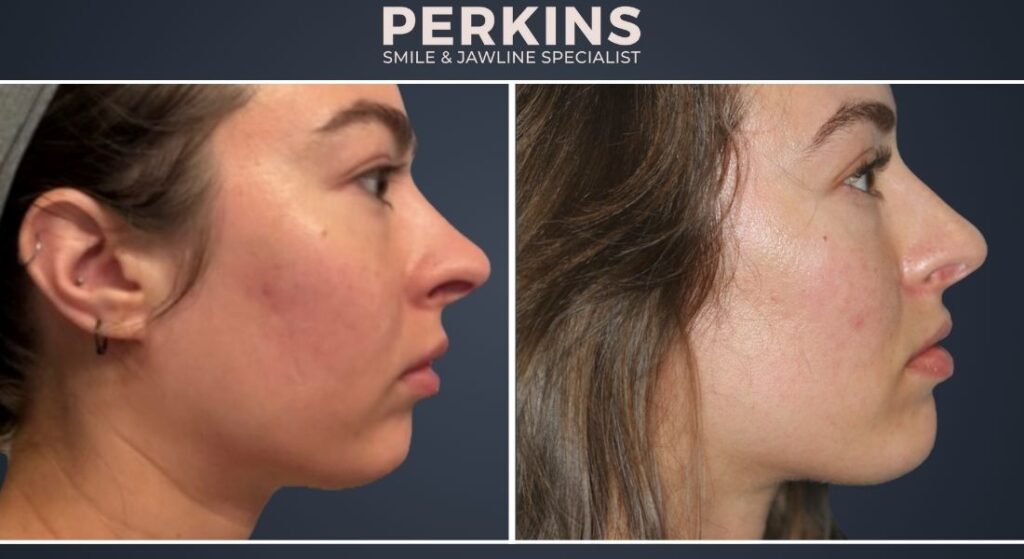
This patient had a retruded jaw and prominent double-chin. By moving her lower jaw to the ideal position, her entire profile was transformed without any surgery in just four weeks. By moving her lower jaw forward using JawAlign©, the soft tissue that created the double chin completely flattened out. Her lip posture changed and her chin looks unrecognizable. These results took about 4 weeks and didn’t require any cutting into bone, metal plates, or any kind of pain or downtime.
JawAlign® vs Jaw Surgery
Jaw Surgery: Corrective jaw surgery (orthognathic surgery) is a procedure that involves surgically cutting and repositioning the upper jaw, lower jaw, or both. After the jaw is moved, it is secured with plates and screws. This surgery usually requires general anesthesia and takes place in a hospital. Recovery can take several months and often includes swelling, a restricted diet, and time away from everyday activities. This procedure is invasive and irreversible, permanently changing the bone structure of the face. For patients with idiopathic condylar resorption, jaw surgery can often make things worse.
JawAlign: JawAlign is a specialized Facial-Driven Dentistry treatment that creates a new bite by moving the jaw into its ideal physiological position naturally. Unlike Jaw Surgery, it does not require any metal plates or screws. There is no pain or downtime. There is no cutting of the bone. There is no need for anesthesia. There is no restricted diet – you can eat whatever you want. And you can even test your new bite before you commit to treatment. For many patients looking for alternatives to corrective jaw surgery, JawAlign is the ideal solution.
JawAlign® vs Orthodontics
Orthodontics: Braces and aligners can improve how the teeth fit together by moving them into better alignment – but this does not reposition the jaw itself. Moving teeth to fit the existing jaw structure may flatten the face or create facial imbalance and does not address the root problem and in some cases can make matters worse.
JawAlign: Unlike orthodontics or camouflage approaches, the JawAlign method by Dr. Bob Perkins addresses the root cause rather than just the symptoms by actually repositioning your jaw into the position it was always meant to be in – not moving teeth to fit an imperfect jaw position.
Jaw Conditions that are Treatable With JawAlign®
Correcting Overbites without Jaw Surgery: A deep overbite is one of the most common reasons patients are told they need jaw surgery. In reality, most overbites do not require cutting bone at all, even though jaw surgery is usually recommended. When the bite forces the lower jaw too far back, it compresses the face, shortens the lower third, and can create tension in the jaw and neck. With JawAlign, we reposition the lower jaw into its ideal physiological position and redesign the bite to support it. This often improves facial balance immediately, without cutting bone or going through years of orthodontics.
Fix Small or Weak Chins: When the lower jaw sits too far back, the chin appears recessed and the profile looks weak. Facial features can look out of balance, such as having a “large” nose or unflattering lip posture. The issue is actually the position of the jaw, not these facial features themselves. Instead of surgically advancing the jaw, JawAlign allows us to bring the jaw into the correct position and support it with the bite. When that happens, the chin projects naturally, the profile improves, and the entire lower face looks more balanced.
Treatment for Underbites without Surgery: An underbite occurs when the lower jaw sits too far forward relative to the upper jaw. Traditionally, this has been treated by surgically moving one or both jaws. With JawAlign, we evaluate where the lower jaw actually belongs in relation to the face and airway, and reposition it accordingly. Once that position is established, we reshape the bite to support it. This allows us to correct many underbites without breaking and repositioning the jaw, while still improving both function and facial aesthetics.
Fix Small, Worn Down Teeth without Drilling: Worn down or undersized teeth reduce the vertical support of the face. Over time, this can cause the jaw to collapse inward, contributing to overbites, aging of the lower face, and loss of definition in the jawline. Traditional approaches often involve aggressive drilling for crowns or veneers. By using JawAlign together with prepless veneers we can restore the proper size and shape of the teeth without removing healthy enamel, while simultaneously supporting the jaw in its correct position.
Fixing Breathing Issues, TMJ, and Jaw Popping/Clicking: Most patients don’t realize that their breathing & TMJ issues are caused by the position of their lower jaw. When the jaw is in the wrong position, the muscles and joints are constantly compensating. This can lead to TMJ pain, clicking or popping, headaches, and even restricted airflow. Many patients are treated with night guards or medications, but these don’t address the underlying mechanical issue. By repositioning the jaw into a more natural, balanced position with JawAlign we can improve TMJ and breathing issues. This is why Facial Driven Dentistry is healthcare and not just cosmetic.
Removing a Double Chin without Surgery: A double chin is not always a fat issue. In many cases, it’s the result of a lower jaw that is positioned too far back. When the jaw sits back, the soft tissue under the chin compresses and loses definition, creating the appearance of fullness or sagging. By repositioning the jaw forward into its ideal position, the chin and jawline become more defined, and the area under the chin tightens naturally. This creates a sharper, more youthful profile without liposuction, injections, or surgery. Read the full guide to whether your double chin is fat, skin, or jaw position.
Treatment Phases of the JawAlign® Jaw Surgery Alternative
Phase 1: First Visit: Your jawline can dramatically change not only the way your face looks, but even the way you speak, breathe, and hold tension in your neck. A strong overbite, underbite, misaligned or protruding jaw, etc are mechanical issues. From your very first visit, we can change the “gearing” of your mouth by placing your bite in its ideal physiological position. You will see an immediate improvement to your facial aesthetics and even improvements to your breathing.
Phase 2: Trial Phase: Unlike jaw surgery, we will never make permanent changes to your bite, jaw, or teeth until you are 100% satisfied with your new look and bite position. After moving your bite to the ideal physilogical position using the JawAlign method, we will place temporary restorations and evaluate you over a period of two to three weeks. This will allow you to try out the new bite in real life; see how it feels when you breathe, talk, eat, sleep, when you look in the mirror. Only when you are absolutely thrilled with your new look will we place the permanent restorations.
Phase 3: Permanent Bite Restoration Only once we have met and exceeded all of your smile expectations in the temporary phase, will we replace the temporaries with the permanent restorations. At this point your overbite or underbite will be permanently fixed without surgery, pain or downtime. You will leave our clinic with as close to a flawless result as possible. Many patients fly in from all over the world to our dental clinic in Malibu, California specifically for this treatment.
Have You Been Told Jaw Surgery is Your Only Option?
Find Out if the JawAlign© Alternative to Jaw Surgery is Right For You

FAQ
- What is orthognathic surgery?
- Who gets recommended for jaw surgery?
- What are the real risks of jaw surgery that surgeons don't always mention?
- How long is the recovery from jaw surgery?
- What is JawAlign and how is it different from jaw surgery?
- Can I see what my result will look like before committing?
- What conditions can JawAlign treat instead of surgery?
- What happens if jaw surgery fails or I am unhappy with the result?
- Is JawAlign more expensive than jaw surgery?
- Why do so many doctors recommend jaw surgery when non-surgical options exist?
- Do I have to live in Malibu or Southern California to be treated?
- What is facial driven dentistry and how does it relate to jaw surgery alternatives?
- What is the best alternative to jaw surgery?
What is orthognathic surgery?
Corrective jaw surgery, also called orthognathic surgery, is a procedure in which an oral and maxillofacial surgeon cuts and repositions the jaw. Once moved, the bones are held in their new position with titanium plates and screws. The surgery takes place in a hospital under general anesthesia and typically requires 12 to 18 months of orthodontics before the procedure to prepare the bite, followed by another 6 to 12 months of orthodontics afterward. Total treatment time from start to finish commonly runs two to three years. It is one of the most invasive procedures in dentistry and results can be unpredictable.
Who gets recommended for jaw surgery?
Patients are typically referred for jaw surgery when an orthodontist or oral surgeon determines that the jaw size discrepancy is too significant to be corrected by moving teeth alone. Common reasons include a severe overbite or underbite, significant facial asymmetry, open bite, or chronic TMJ dysfunction linked to jaw position. What most patients are never told is that the threshold for that recommendation varies significantly between practitioners, and many patients who are told surgery is necessary are actually candidates for JawAlign non-surgical correction.
What are the real risks of jaw surgery that surgeons don't always mention?
Beyond the standard informed consent paperwork, several outcomes catch patients off guard. Permanent nerve damage and numbness in the lips, chin, or tongue affects a percentage of patients and may never fully resolve. The results cannot be previewed before the procedure and If the outcome is not what you expected, there is no path back. Metal plates and screws remain in the jaw permanently unless a second surgery is performed to remove them. And for a significant number of patients, the bite still does not feel right even after the full two to three year process. In fact, in many cases the patient still has a weak chin and profile even after orthognathic surgery. These are outcomes surgeons rarely lead with.
How long is the recovery from jaw surgery?
Most patients are on a liquid or soft food diet for a minimum of four to six weeks immediately after surgery. Some patients report being on a liquid food diet for nearly a year! Significant swelling is common for the first several weeks and can linger for months. Many patients take four to six weeks or even months off work. Bone healing takes up to a year. When you factor in the pre-surgical orthodontics, the surgery, and the post-surgical orthodontics, the full treatment timeline is typically two to three years. Dr. Perkins has seen patients come in after completing this entire process, still unhappy with the result, with no option to undo what was done.
What is JawAlign and how is it different from jaw surgery?
JawAlign is a non-surgical jaw correction method developed by Dr. Bob Perkins that repositions the jaw into its ideal physiological position without cutting bone, without metal plates or screws, without anesthesia, and without downtime. JawAlign finds where the jaw actually belongs non-invasively, and builds the bite to support that position using prepless restorations that bond over the teeth without drilling them down. The result is completed in weeks and the outcome can be tested and approved before anything is made permanent.
Can I see what my result will look like before committing?
For Jaw Surgery: NO. For the JawAlign Jaw Surgery Alternative: YES! With jaw surgery, you commit to a permanent, irreversible procedure with no ability to preview the outcome. With JawAlign, Dr. Perkins shows you what your corrected jaw position looks like on your very first visit. Temporary restorations then hold your jaw in that position for two to three weeks so you can live with the new bite in real life (eating, speaking, breathing, sleeping) before anything permanent is placed. Nothing becomes permanent until you are completely satisfied.
What conditions can JawAlign treat instead of surgery?
JawAlign can treat most of the conditions for which jaw surgery is routinely recommended, including deep overbites, underbites, recessed or weak chin appearance, double chin caused by jaw position, TMJ pain and dysfunction, open bites, crossbites, worn down teeth, facial collapse from bite loss, and restricted airway and breathing issues. However, it may not be appropriate in some extreme cases, but this represents a small minority of patients who are referred for orthognathic surgery.
What happens if jaw surgery fails or I am unhappy with the result?
This is a situation Dr. Perkins sees regularly. Patients who went through the full surgical process; the pre-surgical braces, the hospital procedure, the recovery, the post-surgical braces.. and still are not happy with their bite or their face. Because the bone has been permanently cut and repositioned, conventional revision requires another surgery. You cannot uncut bone. However, JawAlign has successfully treated patients in this situation. Even after jaw surgery, the jaw can often be repositioned further using the JawAlign method to achieve the functional and aesthetic result the patient was originally seeking. The best option is to avoid surgery altogether by coming in for a consultation with Dr. Perkins in Malibu, California.
Is JawAlign more expensive than jaw surgery?
When considering the cost of JawAlign, you need to look at the full picture. Orthognathic surgery itself typically runs $20,000 to $40,000 out of pocket, and that does not include the 18 to 36 months of orthodontics before and after, time off work during recovery, or the costs of revision if the result is not satisfactory. The cost of JawAlign is comparable to surgery, however it is completed in weeks with no downtime, no hospital, no orthodontics required, and is guaranteed to transform your look before you commit to treatment. The office will submit claims to your insurance on your behalf for any functional components of treatment, and financing options are available.
Why do so many doctors recommend jaw surgery when non-surgical options exist?
Oral surgeons and orthodontists are trained within a system that treats jaw problems through movement of teeth and surgical repositioning of bone. JawAlign is a revolutionary non-surgical approach that most doctors simply aren’t aware of. Non-surgical jaw correction using prepless restorations to hold the jaw in a physiologically correct position is not part of standard dental school or surgical training. Most practitioners recommending surgery are not being dishonest. They are recommending the best option they know how to perform.
Do I have to live in Malibu or Southern California to be treated?
No. Dr. Perkins treats patients from across the United States and even internationally. Many patients fly in specifically for the JawAlign treatment because it is not available elsewhere. Because the process involves a first visit, a two to three week trial phase, and a permanent restoration appointment, many out-of-state patients plan two trips. The office can help coordinate treatment around travel schedules.
What is facial driven dentistry and how does it relate to jaw surgery alternatives?
Facial Driven Dentistry is Dr. Perkins’ philosophy and treatment approach. Dental treatment should improve not just the teeth, but the face, the jaw, the airway, and overall health. Unlike conventional dentistry, which focuses solely on the teeth, It is this philosophy that leads to both JawAlign and No Prep Porcelain Veneers creating superior aesthetic and health outcomes to alternative treatment options.
What is the best alternative to jaw surgery?
For patients told they need surgery due to a skeletal overbite, underbite, recessed jaw, or bite collapse, JawAlign is the most comprehensive non-surgical option available. Unlike braces, which only move teeth, or camouflage orthodontics, which mask the problem without fixing it, JawAlign actually repositions the jaw into its correct physiological position and builds the bite to hold it there permanently without cutting bone, without anesthesia, and without downtime. Patients get a corrected bite, improved facial proportions, a more defined chin and jawline, better breathing, TMJ relief, and they can trial treatment before anything is made permanent.
Have You Been Told Jaw Surgery is Your Only Option?
Find Out if the JawAlign© Alternative to Jaw Surgery is Right For You