DR. BOB PERKINS DDS
How to Get Rid of a Double Chin Without Surgery
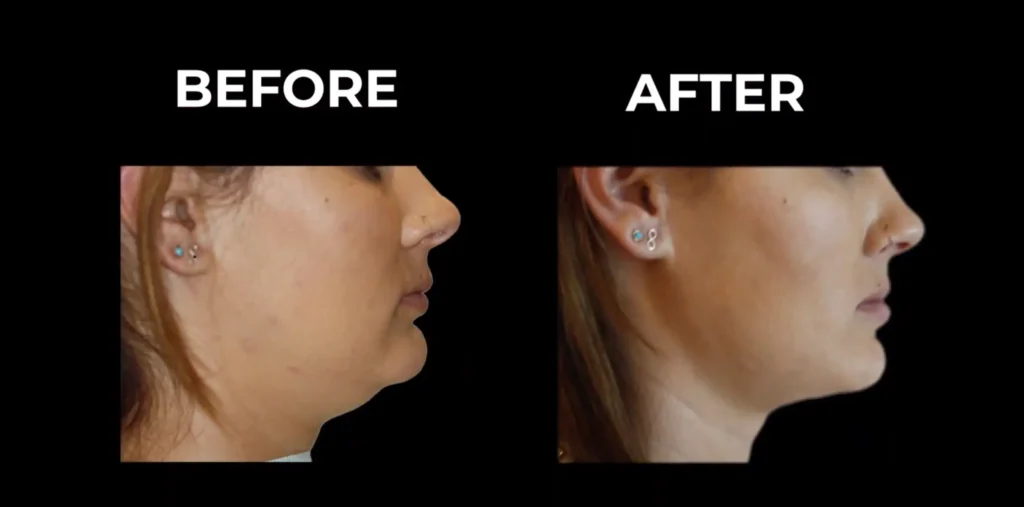
A double chin usually comes from one of three things: stored fat, loose or aged skin, or a lower jaw set further back than it should sit. Most articles on this topic only ever cover the first one.
Dr. Bob Perkins has spent more than 25 years treating the third cause, jaw position, and cites research showing 95% of jaw and bite positions are acquired through childhood development, not inherited.
A jaw-position double chin cannot be fixed with fat treatment alone, but a fat-driven one may still benefit from jaw work if the jaw is not in its ideal physiological positon. Below is a one-minute self-check to find out which cause is actually behind yours and how to fix it without surgery.
Jump to:
- What Causes a Double Chin?
- Self-Check: Fat, Skin, or Jaw Position?
- Can a Double Chin Be Fixed Without Surgery?
- Why Traditional Non-Surgical Options Fail
- Non-Surgical Options That Correct Jaw Position
- Why Exercises and Neck Straps Don’t Change Jaw Position
- What This Looks Like: Real Patients
- Is a Non-Surgical Fix Right for You?
- FAQ
What Causes a Double Chin? (Fat, Loose Skin, or Jaw Position)
A double chin can come from three things: stored fat under the chin, loose or aged skin, or a lower jaw positioned behind where it should sit, which pulls the chin-neck angle back and lets the tissue beneath it sag. And sometimes a double-chin may be a result of all three conditions at once. Most guides online only explain the first cause.
These three causes are not exclusive of each other, and they often show up together in the same person. Dr. Perkins writes about this in his book, The Health Nexus, explaining that a lower jaw without enough forward support leaves facial skin as, in his words, “a sack of soft tissue” with nothing underneath to hold it up. Without that support, it sags, wrinkles, and creases.
Dr. Perkins cites research from Dr. Jerome Rose showing 95% of jaw and bite positions are acquired through how a person breathes and develops as a child, not inherited. Only 5% is genetics. That same acquired development is why a poorly positioned jaw can also cause a deep overbite, and why childhood breathing patterns shape jaw position long before a double chin ever becomes visible in the mirror.
The chin-neck angle, the visible line where the underside of the chin meets the front of the neck, and chin projection, how far forward the chin sits relative to the rest of the face, are the two clearest tells for telling these causes apart. That’s what the self-check below is built around.
| Cause | What it looks like |
|---|---|
| Stored fat | Soft fullness under the chin that tracks with body weight. Smaller at a lower weight, more noticeable at a higher one. |
| Loose or aged skin | Skin laxity without much underlying fullness. More crepey or sagging than firm, often more visible with the head tilted back. |
| Jaw position | Present at any body weight, including a lean one. The chin looks set back in profile, and the chin-neck angle looks blunt or missing even from the front. |
Self-Check: Is Your Double Chin Fat, Skin, or Jaw Position?
This takes about a minute. Stand in front of a mirror, in profile if you can manage it, and work through the signs below one at a time.
The lean-weight test carries the most weight of any sign here, because it isolates the one variable fat can’t fake. Fat under the chin tracks with body weight almost every time. It shrinks when weight drops and comes back when it climbs. Fullness that stays put at a stable, lean weight has nowhere else to come from except loose skin or a jaw that sits too far back, which is why that single question does more diagnostic work than any other row below.
No single sign proves a category on its own. Together, they point you toward the most likely one.
| Sign observed | Likely cause |
|---|---|
| Fullness under the chin shrinks noticeably when you lose weight, or grows when you gain it | Stored fat |
| Skin under the chin looks loose, crepey, or sags more than it looks full, especially with your head tilted back | Loose or aged skin, or a mix |
| Fullness is present even at a stable, lean body weight | Jaw position, or a mix |
| In profile, your chin looks set back rather than roughly aligned with your upper lip and forehead | Jaw position |
| Pinching the skin under your chin picks up mostly skin, with little firm tissue underneath | Loose or aged skin, not fat |
Most people land clearly in one category after two or three rows. If your answers split between categories (fullness that shrinks somewhat with weight loss but never fully goes away, for example), you likely have some overlap, and both of the next two sections apply to you.
If your answers point toward stored fat or skin, the next section covers what actually works. If they point toward jaw position, keep going. The fix looks different, and it’s the one most double chin guides online never mention.
Can a Double Chin Be Fixed Without Surgery?
Yes, a double chin can be fixed without surgery for most people, whether the cause is fat, skin, or jaw position, though the fix looks completely different depending on which one it is. Most patients who are told they need jaw surgery do not actually need it, and Dr. Perkins has spent more than 25 years proving it, working with hundreds of people to reposition or expand jaws without a scalpel. The sections below cover the non-surgical route for each cause, starting with fat and skin.
Where Traditional Non-Surgical Options for Fat or Skin Fail
If your self-check points to fat or skin, there are several well-known options that exist. Kybella (deoxycholic acid) is the FDA-approved injectable for moderate to severe fullness caused by submental fat in adults. It works by breaking down fat cell membranes in the treated area, usually across a series of sessions spaced weeks apart.
CoolSculpting uses controlled cooling instead of an injection to gradually reduce fat cell count in the same area. Both target stored fat specifically.
However, neither of these treatments touches loose or sagging skin, and neither one changes the chin-neck angle in a jaw-position case.
A 2021 systematic review published in APOS Trends in Orthodontics found that moving the jaw forward measurably improves the chin-neck angle, a different mechanism entirely from dissolving or freezing fat cells. Diet and exercise can modestly improve the look of a fat-driven double chin over time, but they don’t reach loose skin, and they don’t reach a jaw that’s set too far back. For those causes, the next two sections cover what actually helps.
Non-Surgical Options For Fixing a Double-Chin Caused by Jaw Position
For most patients, the best non-surgical solution to fixing a double-chin is not injections. The best solution fixes the root of the problem by correcting the jaw position itself, non-surgically. Dr. Perkins developed JawAlign™, a non-surgical protocol for repositioning or expanding the jaw, as part of his broader Facial Driven Dentistry™ approach, which treats the jaw, teeth, and face as one connected system rather than separate cosmetic problems.
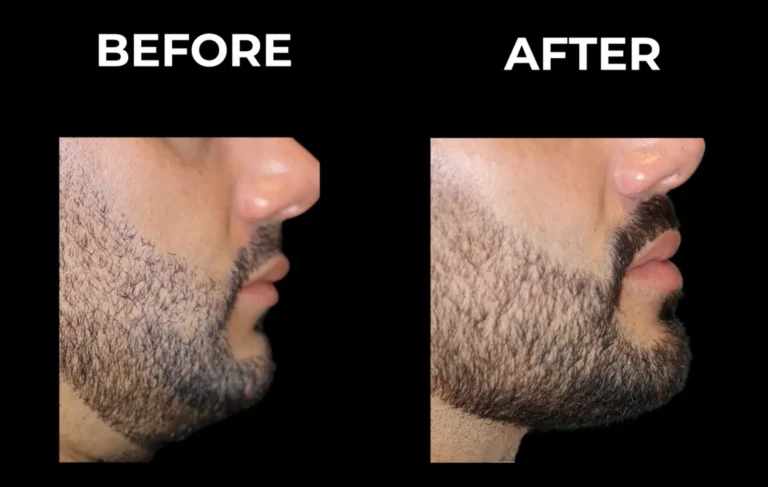
JawAlign produces a visible profile change at the first visit, with a 2 to 3 week trial phase to confirm the result before it’s made permanent, compared to the 2 to 3 year total timeline of a surgical jaw-repositioning route. During the trial phase, patients are able to see and feel the corrected jaw position before anything is finalized. No drilling, no cutting, and no committing to a result nobody has seen yet.
Compare that to the surgical alternative most patients are quoted. Jaw repositioning surgery typically runs $20,000 to $40,000 out of pocket, plus 12 to 18 months of orthodontics beforehand and another 6 to 12 months after. The total commitment usually lands at 2 to 3 years from first consult to finished treatment. That includes 4 to 6 weeks on a liquid or soft diet during initial healing (some patients report closer to a year before eating normally again) and up to a year of bone healing on top of that. See the full comparison to jaw surgery
For patients who also want to address tooth appearance at the same time, JawAlign pairs with prepless porcelain veneers, which bond directly to existing enamel instead of grinding healthy teeth down to fit a veneer. JawAlign’s jaw position correction is what lets patients avoid the surgical route entirely. The practice is out-of-network with insurance providers but submits claims for functional components of treatment where applicable, and financing is available for patients weighing the investment against a multi-year surgical alternative.
None of this applies to a purely fat-driven or skin-driven double chin where the jaw is already in its ideal physiological position – but this is often not the case.
Why Exercises and Neck Straps Don’t Change Jaw Position
Exercise and neck straps can modestly tighten the muscles under the chin, and for a fat-driven double chin, some patients notice a little improvement in tone over time. Neither one does anything to move bone. Dr. Perkins writes in his book that when the lower jaw doesn’t sit far enough forward, facial skin loses its underlying support and becomes a sack of soft tissue that sags, wrinkles, and creases along the jaw and neck.
No amount of chin exercise changes where the jawbone sits. If the self-check above pointed to jaw position, exercises and straps will tighten skin that’s sagging for a structural reason, not a muscular one, and the chin-neck angle will look the same once you stop.
What This Looks Like: Real Patients
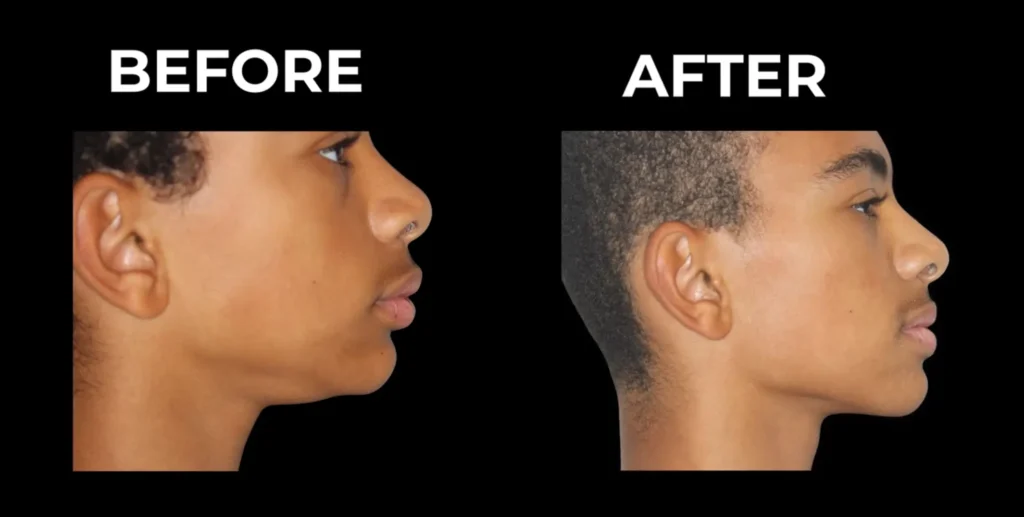
Look closely at the jawline in the after photo. This young patient came to Dr. Perkins with a lower jaw that sat well behind where it belonged, which flattened his chin-neck angle and softened the entire lower third of his face. JawAlign™ moved that jaw into its ideal position in a matter of weeks.
He never wore braces, and nothing was injected or cut. What the after photo shows is the same young face with the support it should have had all along: a jawline with a real edge to it and a profile ready for Hollywood.
Leah’s jaw sat further back than it should have, softening her profile in a way that made her look older than she was. She noticed the change during the JawAlign trial phase, before any permanent work was done, and so did her family. She talks about it in her own words in the video below.
For more real results across both JawAlign and prepless veneers cases, see the full before-and-after gallery.
Is a Non-Surgical Fix Right for You?
For most people with a jaw-position double chin, whether it’s the only cause or it’s overlapping with fat or skin, a non-surgical fix works. Dr. Perkins has helped hundreds of patients reposition or expand jaws over more than 25 years, and the patients who are told they need jaw surgery usually don’t. Surgery is genuinely the right call for a small subset of extreme skeletal discrepancies, and Dr. Perkins will say so plainly when that’s the case.
A purely fat-driven double chin will not change from jaw repositioning. That combination only helps when a recessed jaw or a weak chin-neck angle is part of the cause. If your self-check pointed toward stored fat with no structural component, a fat treatment is the honest next step, not JawAlign. If it pointed toward jaw position, see why most patients told they need surgery don’t and find out if a non-surgical fix is right for your case.

Double Chin Questions People Ask Dr. Perkins
- Will Kybella or CoolSculpting get rid of a double chin?
- What if other treatments already failed?
- Can braces or Invisalign fix a double chin?
- Do chin exercises or mewing get rid of a double chin?
- Do you really need jaw surgery to fix a double chin?
- Why has no doctor ever mentioned jaw position as a cause?
- Does a double chin get worse with age?
- Can you see the result before committing to anything?
- Does JawAlign require drilling or downtime?
- Is the result permanent, or will a double chin come back?
- What does it cost compared to surgery or repeat fat treatments?
- How do you know if a double chin is coming from jaw position?
Will Kybella or CoolSculpting get rid of a double chin?
Only when stored fat is the entire cause, which is less common than the marketing suggests. Kybella breaks down fat cell membranes with an injection, and CoolSculpting freezes fat cells so the body clears them over time. Neither one tightens loose skin, and neither one moves the jaw that sets the chin-neck angle in the first place.
This is why patients finish a full series of treatments, look in the mirror, and still see the same soft line under the chin. When a jaw sitting too far back is casting that shadow, no amount of fat reduction will change it.
What if other treatments already failed?
This is a situation Dr. Perkins sees regularly, and it is usually good news. A treatment aimed at fat or skin that produced little or no visible change is strong evidence that neither one was the main driver. The chin-neck angle was being set by jaw position the whole time, which is exactly what JawAlign™ corrects.
Anything tried previously rules nobody out. The evaluation looks at where the jaw sits now and what the profile does when it moves forward into its ideal position.
Can braces or Invisalign fix a double chin?
No. Orthodontics moves teeth through bone. It does not move the jaw those teeth are attached to. Patients regularly spend eighteen months or longer in braces or aligners, finish with beautifully straight teeth, and see no change whatsoever in the profile, because the lower jaw is still sitting exactly where it started.
Correcting jaw position itself is what changes how the lower face reads in a side photo. Dr. Perkins has been correcting bites this way for more than 25 years, and JawAlign™ does it in a few weeks.
Do chin exercises or mewing get rid of a double chin?
No. Both work on muscle and soft tissue, and jaw position is skeletal. Tongue posture genuinely matters while a child’s face is still developing, which is the science Dr. Perkins covers in The Health Nexus. By adulthood the jaw has finished growing, and its position has to be physically moved for the profile to change.
Patients who commit months to these routines end up exactly where they started, which is a frustrating and completely avoidable detour.
Do you really need jaw surgery to fix a double chin?
Usually not. Dr. Perkins has spent more than 25 years moving jaws into their ideal position without a scalpel, and most patients who arrive holding a surgical treatment plan turn out to be excellent non-surgical candidates.
What most patients are never told is that the threshold for recommending surgery varies enormously between practitioners. Surgery is genuinely the right call for a small number of extreme skeletal cases, and Dr. Perkins says so plainly when he sees one. For everyone else the surgical route means roughly $20,000 to $40,000 out of pocket and two to three years from first consult to finished treatment. See the full comparison to jaw surgery.
Why has no doctor ever mentioned jaw position as a cause?
Because it sits outside what most practitioners are trained to look for. Dermatologists and med spas are trained to treat the tissue they can see, so they treat fat and skin. Orthodontists are trained to move teeth, and surgeons are trained to cut and reposition bone.
Non-surgical jaw repositioning using prepless restorations is not part of standard dental school or medical training. Most practitioners who never raise jaw position are not being dishonest. They are recommending the best option they know how to perform. Dr. Perkins’ background is built specifically around this work.
Does a double chin get worse with age?
Yes, and the reason is structural. The skin and soft tissue of the lower face depend on the jaw underneath them for support. When that jaw sits too far back, the tissue beneath the chin has nowhere to go, so it sags earlier and the chin-neck angle keeps softening as collagen declines.
Restoring jaw position restores the support underneath, which is why patients in their 50s through 70s often see the most dramatic change of anyone.
Can you see the result before committing to anything?
For jaw surgery: no. For JawAlign™: yes.
Surgery asks a patient to commit to an irreversible procedure with no way to preview the outcome. With JawAlign, Dr. Perkins shows the corrected jaw position at the very first visit, and temporary restorations then hold the jaw there for two to three weeks. Patients eat, speak, sleep, and photograph themselves in the new position before anything is finalized.
Nothing becomes permanent until the patient is completely satisfied with how it looks and feels.
Does JawAlign require drilling or downtime?
No. Healthy enamel stays intact and nothing is cut. There is no recovery period to schedule around, and patients eat normally the same day.
Surgical jaw repositioning, by comparison, commonly involves four to six weeks on a soft or liquid diet, with some patients reporting closer to a year, plus bone healing that can take a full year on top of that.
Is the result permanent, or will a double chin come back?
The corrected jaw position is permanent once treatment is finished. It is held by restorations that bond over the teeth, so there is nothing to top up and nothing that fades.
Filler and fat treatments work the other way. The body processes them over time, which means repeat appointments and repeat cost to hold any result at all.
What does it cost compared to surgery or repeat fat treatments?
JawAlign™ asks an investment comparable to jaw surgery and completes the correction in weeks instead of years. Fat treatments look cheaper per session, but they are priced per round, they need repeating to hold any effect, and they leave jaw position untouched.
| Jaw surgery | Injections or cooling | JawAlign | |
|---|---|---|---|
| Total time | 2 to 3 years | Repeat sessions, ongoing | A few weeks |
| Changes jaw position | Yes, by cutting bone | No | Yes, without cutting |
| Reversible trial first | No | No | Yes, 2 to 3 weeks |
| Needs repeating | No | Yes | No |
The office is out-of-network with all insurance providers, but the team submits claims for the functional components of treatment, and financing is available.
How do you know if a double chin is coming from jaw position?
The self-check on this page points most people in the right direction, and an evaluation confirms it. Dr. Perkins examines how the jaw sits and what happens to the profile when it is brought forward into its ideal position, which is a change patients can see during that same visit.
Patients travel to the Malibu practice from across Southern California and well beyond, and many fly in specifically because this treatment is not offered elsewhere. Contact the Malibu office to book an evaluation.
See What Your Profile Looks Like Without the Double Chin
Call (424) 587-3930 or Request a Consultation Below.