Dr. Perkins and his staff are super friendly and easy to communicate with. Dr. Perkins is a perfectionist and worked tirelessly on adjusting my bite. He wants to make sure his clients are satisfied.
- Home
- »
- Overbite Correction Without Surgery
DR. BOB PERKINS DDS
Overbite Correction in Weeks Without Surgery or Braces Malibu, CA
If you have a deep overbite, chances are you’ve been told that surgery is your only real option. You’ve been handed a referral to an oral surgeon, given a timeline of months of orthodontics before and after the procedure, and told to clear your calendar for a recovery period that stretches into the better part of a year. What most patients are never told is that the majority of overbites do not require cutting bone (or aligners of any kind) and can now be fixed in a few short weeks with revolutionary non-invasive dentistry.
What Is an Overbite?
An overbite is a dental and skeletal condition in which the upper front teeth overlap the lower front teeth vertically by more than 2–3 millimeters. A small degree of overlap is normal and present in most people. When the overlap exceeds this range, it is classified as a deep bite or malocclusion and typically requires treatment. Most patients are told they have either a “dental” overbite, caused by tooth position, or a “skeletal” overbite, caused by jaw position. What most are never told is that a purely dental overbite is actually uncommon in adults. The reality is that overbites are almost never caused by tooth position alone.
For most people with a significant overbite, the jaw itself is the problem. Braces and aligners can move teeth, but they cannot move the jaw. This is why so many patients get bounced between orthodontists and without ever finding a clear path forward. While jaw surgery used to be the only option to correct skeletal overbites, there is now a revolutionary non-invasive option that fixes overbites in a few short weeks.
What are the signs and symptoms of an overbite? If you have a deep overbite you might recognize some of these:
- Upper front teeth that significantly cover the lower front teeth when biting down
- A recessed or small-looking chin caused by the lower jaw being pushed back
- A shorter, rounder lower face than normal facial proportions would produce
- Inward-slanting upper front teeth
- TMJ pain, jaw clicking, or jaw fatigue
- Headaches and neck tension from chronic muscle compensation
- Accelerated tooth wear, particularly on the lower front teeth
- Restricted airway and poor sleep quality
- A resting facial expression that appears tense or prematurely aged
No Braces, Aligners, Extenders, Drilling, or Surgery
Many patients have seen orthodontists for consultation and been steered towards braces or clear aligners to correct their overbite. However, these orthodontic options are unappealing for a number of reasons. Many patients have tried braces or clear aligners (sometimes more than once) only to see the bite eventually relapse. These devices are amazing for straightening teeth, but cannot fix the real cause of overbites. Other patients have been convinced by cosmetic dentists that veneers or crowns alone can fix an overbite. This again is not the case.
Fortunately, deep overbites can now be treated in a few weeks with the revolutionary JawAlign method. This is a proven, non-surgical treatment that can achieve the highest level of bite optimization, comfort, aesthetics, and health benefits in a few short weeks with absolutely no downtime or drilling down teeth. For many patients, this is the ideal solution to correct their overbite. But most have not been educated by healthcare practitioners about the JawAlign method.
Proven Overbite Correction
In Weeks, Not Months
Without Aligners, Extenders, or Surgery
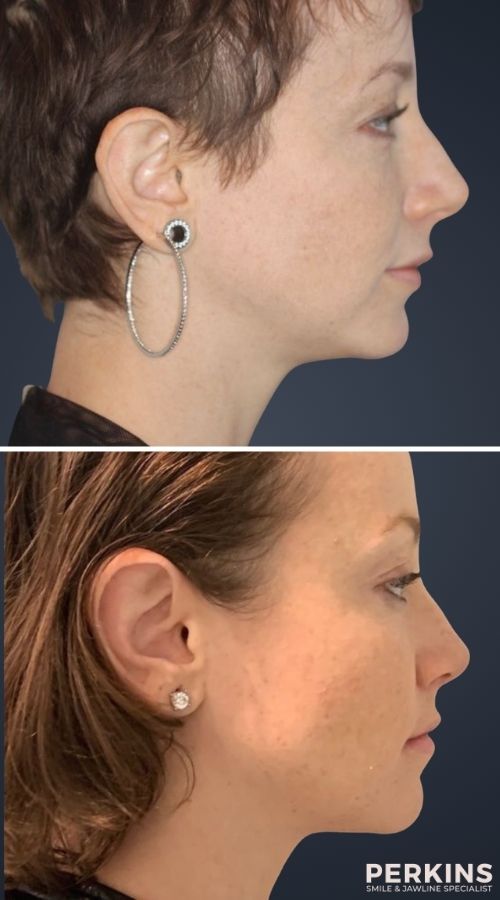
Overbite Correction Starts by Aligning the Jaw, Not the Teeth
Most people think of an overbite as a dental problem. Others are unhappy with their side profile and think they need plastic surgery without realizing they actually have an overbite. In reality, when the lower jaw is pushed back it changes the entire appearance of the face. A deep overbite pushes the mandible backward and upward, closing the jaw too close to the nose. This is why overbite patients often have short, round faces and a small-looking chins. The chin itself is actually a perfectly normal size.
Moving teeth does not move the jaw. Dr. Perkins sees this regularly. Patients who relapsed after braces. Patients whose aligners made the bite worse. Patients who went through jaw surgery and are still unhappy with the result. Patients with porcelain veneers that required grinding down healthy teeth and still left them with TMJ pain. And older patients whose bite has deepened with age, bringing a receding chin, a shorter face, worsening breathing and sleep problems, and an “aging” face.
One of the most revolutionary approach in modern dentistry is the JawAlign method, which gives patients a comfortable, healthy bite position and a remarkable aesthetic that can rarely be achieved with traditional cosmetic dentistry and veneers – all without surgery, braces, or removing a single millimeter of healthy enamel. And it is effective for overbite patients young and old.
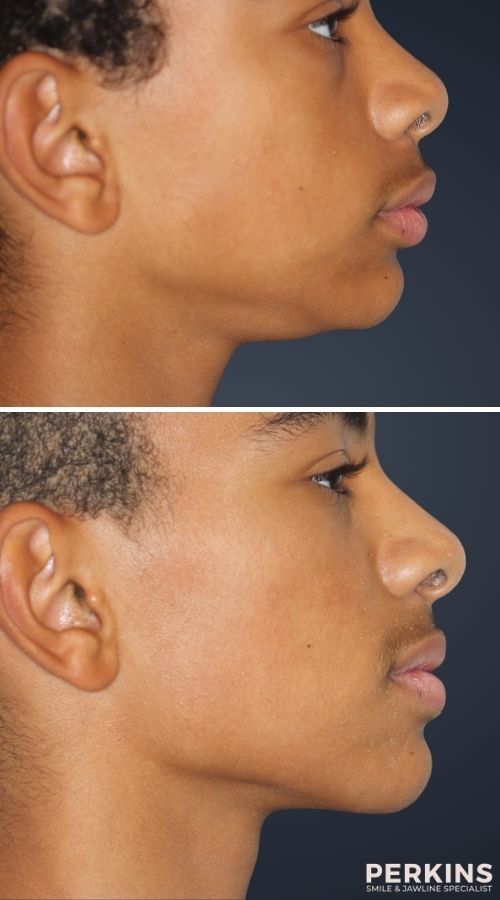
To fill the patient need for overbite corretion, Dr. Perkins has developed a fast, non-invasive solution to correct severe overbites without surgery or braces that actually changes the position of the jaw. Candidates for this procedure are able to save themselves from jaw surgery recovery and time-consuming orthodontics that don't address the real problem.
Benefits of JawAlign Non-Surgical Overbite Correction
- Better Sleep and Breathing. An overbite pushes the jaw back, which narrows the airway. A narrow airway means poor sleep, low energy, and in many cases sleep-disordered breathing or apnea. Our patients consistently report sleeping better, breathing more easily, and having more energy after treatment.
- A More Attractive, Defined Jawline. Your nose isn’t too large and your chin isn’t too small. Your face looks out of proportion because the jaw is being pushed back by the overbite. When we move the jaw into its correct position with JawAlign, the chin and lips project naturally to where they were always meant to be. For men this creates a chiseled, more masculine look. For women, it creates a beautiful more feminine profile.
- TMJ Pain and Headaches. Most patients with TMJ pain have no idea their bite is causing it. When the jaw is forced into the wrong position, the muscles and joints compensate which leads to chronic pain. JawAlign is a physical solution to a physical problem. For some patients, the TMJ pain is what brings them in. The cosmetic transformation is a bonus.
- Anti-Aging and Facial Harmony. As an overbite deepens over time, the soft tissue that had been supported by a correctly positioned jaw has nothing to hold it forward…and begins to sag. It looks like jowling, sagging skin, double chin, thin and inward turned lips, a face that looks tired and collapsed. Most patients have no idea that a retreating jaw is diving many of these aging effects. When JawAlign moves the jaw into its correct position and specialized no prep porcelain veneers lengthen the teeth, we solve many of these facial aging symptoms and patients report looking 10 or more years younger!
- Non-Invasive Dentistry. Most severe bite correction methods require grinding teeth down or surgically repositioning the jaw by cutting bone and installing metal plates and screws. JawAlign requires none of that! It’s no wonder patients fly from all over the world to Malibu, California for the JawAlign method.
- Only Takes a Few Weeks. Braces for an overbite typically run 12 to 36 months. If surgery is involved, add 12 to 18 months of orthodontics before the procedure, the surgery itself, a liquid diet for four weeks during initial healing, another 6 to 12 months of braces afterward, and full bone healing that takes up to a year post-surgery. The total commitment from start to finish is commonly two to three years. JawAlign takes a few weeks! There are no monthly adjustment appointments, no food restrictions, no recovery period, and no clearing your schedule. Most patients come in, go through a trial phase of two to three weeks to test and confirm the result, and leave with permanent restorations shortly after.
Correct Your Overbite
Naturally
Without Aligners, Extenders, or Injections
How JawAlign Overbite Correction Works
Step 1: Finding Where Your Jaw Actually Belongs
On the first visit, Dr. Perkins identifies the ideal physiological position of your lower jaw. This is the position where your muscles, joints, facial structures, and airway function sit in natural balance. Most patients see a visible change in their facial profile at this appointment in just a few minutes.
Step 2: Testing the Result Before Committing to It
This is what makes the JawAlign method so different from every other option. Rather than making permanent changes and hoping for the best, Dr. Perkins places temporary restorations that hold the jaw in its new position for 2–3 weeks. You eat, speak, sleep, and live your normal life in this new bite. You experience exactly what your corrected overbite feels and looks like in real life before any permanent work is done. If you are not completely satisfied, adjustments are made. Nothing becomes permanent until you say so.
Step 3: Permanent Restoration
Once the jaw position has been tested, confirmed, and approved, the temporary restorations are replaced with permanent, high-quality prepless restorations. No healthy tooth structure is removed. The jaw stays in its correct position permanently. The overbite is corrected. The process from first visit to permanent result typically takes a few weeks.
What to Expect After Overbite Correction Treatment
You don’t have to wonder what the result of treatment will be like or worry if it won’t be the result you’re hoping for. That is the worry that comes with traditional treatments like orthognathic surgery and braces. No, with JawAlign you can see and feel your transformation before anything is ever made permanent.
Unlike other overbite treatment options, JawAlign is a remarkable risk-free non-surgical treatment that allows you to experience your new bite so you know exacty what to expect when treatment is complete. You can see more photos on this website or videos on our Youtube channel and other places of our amazing before and afters so you can get an idea of what may be possible for you.
Brando Torres

My face harmonized, jawline sharpened, airway expanded, TMJ healed, and finally have the million dollar smile I’ve always wanted… the way I look, talk, and even how I pronounce my words have all changed for the better. I upgraded my life in the blink of an eye, and would do it all over again if I had to.
Zachary Lichaa
I went into Dr. Perkins to fix my jaw due to a severe overbite. I came out of his office with a new smile and a reconstructed facial structure. Dr. Perkins truly cares about his patients and dedicates a lot of time and energy to make sure his patients are happy and looking great. I highly recommend giving Dr. Perkins a visit, you wont regret it!
Bradley S.
I really was looking for someone to address my profile and bite issues. I am so happy to have found someone who knew exactly how to give me the results I was looking for. I was so afraid of surgery and orthodontics made no sense with my condition. Grateful!
How Much Does JawAlign Overbite Correction Cost?
When you compare the cost of JawAlign to the alternatives, you have to look at the full picture. Jaw surgery with pre and post-surgical orthodontics typically runs two to three years and costs between $20,000 and $40,000 out of pocket before you factor in time off work, liquid diet recovery, and the very real possibility that the result isn’t what you hoped for.
Unlike invasive surgery, JawAlign gives you the ability to see and experience your result before anything is made permanent. No other method offers that. You test your new jaw position, live with it for a few weeks, approve it, and then it becomes permanent. The process takes weeks instead of years, involves no downtime, no hospital, no drugs, no destruction of healthy teeth, is non-invasive and comes with amazing aesthetic and health benefits.
Dr. Perkins has successfully treated patients ranging from teenagers to patients in their nineties, addressing overbites, underbites, crossbites, collapsed bites, TMJ disorders, and sleep-related breathing issues. For patients who have already been through surgery or braces that didn’t work, JawAlign has delivered the result they were originally looking for.
To discuss cost and find out whether you are a candidate, contact our office to schedule a consultation. You will see what your result looks like from the very first visit.
Conventional Overbite Treatment Options and Considerations
Before committing to any treatment, it helps to understand what each option actually involves and what it can and cannot do:
Braces or Clear Aligners typically take 18 months to 3 years. These devices are effective for straightening teeth, but not for fixing overbites since the underlying jaw position never changes. Many patients have been through braces more than once and still have the same problem.
- Orthognathic Jaw Surgery requires 12 to 18 months of orthodontics before the procedure, the surgery itself under general anesthesia, weeks of restricted eating and speaking during recovery, and another 6 to 12 months of braces afterward. Total treatment time runs 2 to 3 years. The outcome is unpredictable and cannot be previewed beforehand. Bone is permanently cut and repositioned with no path back if the result is not what was expected.
- Crowns and Veneers do not change the position of the lower jaw (mandible). Most dentists who attempt bite correction with crowns require drilling every healthy tooth down to a peg first. Beyond the permanent destruction of healthy tooth structure, this approach may open the bite vertically, but does not move the lower jaw into the correct position. This leaves many patients with sensitivity, TMJ problems, and a bite that still does not feel right.
Cosmetic Camouflage uses orthodontics or restorations to make the bite appear more acceptable without correcting the jaw. It can improve aesthetics superficially but does nothing for jaw function, airway, TMJ health, or long-term stability.
JawAlign corrects the overbite by finding where the jaw actually belongs first, testing that position in temporary restorations for 2 to 3 weeks so the patient can experience and approve the result, then making it permanent without surgery, without braces, and without removing a single millimeter of healthy tooth structure. Most patients complete treatment in a matter of weeks with no downtime.
Felicia Ferrance
Karen Hancock
I honestly can’t say enough about Dr. Bob Perkins and his amazing team. I recently went in for veneers, and he ended up realigning my jaw as well. I’d been dealing with painful jaw alignment issues and an overbite for decades, but Dr. Perkins completely fixed my bite. My jaw feels so much better and much more relaxed now. With my jaw properly aligned, we started the process of crafting my veneers.
Tiffany Castillo
Dr.Perkins said a great job of changing my bite and giving me a much better profile.My body is so much more comfortable in my face looks really proportional now.Everything went great.He never had to drill on my teeth his a genius there is no one else that could do this for me thank you Dr.Perkins 😊
FAQ
- What is bite correction?
- What is an overbite?
- What causes an overbite?
- How do you correct an overbite?
- Do I need surgery to fix my overbite?
- Can overbites be fixed with crowns?
- What is the difference between a dental and skeletal overbite?
- How long does it take to correct an overbite?
- Is there an age limit on when an overbite or underbite can be corrected?
- Besides the aesthetic concerns, are there any health issues I should be aware of concering overbites or underbites?
- Will insurance cover non-surgical overbite correction?
- Can I fix my overbite if I already had braces?
- What if I have an underbite, open bite, or crossbite?
What is bite correction?
Bite correction is the process of bringing the upper and lower jaw into a functional, comfortable, and balanced relationship. The term gets used broadly, but there is an important difference between moving teeth around within a jaw that is in the wrong position and actually repositioning the jaw itself. Most conventional bite correction, including braces, aligners, and traditional full mouth reconstruction, addresses tooth position. Revolutionary non-invasive JawAlign treatment addresses jaw position. That distinction is why so many patients who have already had “bite correction” come to us still looking for a result.
What is an overbite?
An overbite is when the upper front teeth overlap the lower front teeth by more than the normal 2 to 3 millimeters. A small degree of overlap is healthy and necessary. When the overlap becomes excessive, it puts uneven forces on the teeth and jaw joints, changes the shape of the face, and often signals that the lower jaw is being held in a position further back than it should be. Overbites are one of the most common bite problems in the modern world, and they are almost always underestimated by the people who have them.
What causes an overbite?
Overbites are caused by a combination of genetics, jaw development, and environmental forces. Additionally, when children breathe through their mouth instead of their nose (often due to enlarged tonsils, adenoids, or allergies) the tongue drops from the roof of the mouth, the upper arch narrows, and the lower jaw shifts back. As Dr. Bob Perkins explains in The Health Nexus, modern humans have smaller, more retruded jaws than our ancestors. Childhood habits like thumb-sucking worsen the problem, and tooth wear causes the bite to deepen further with age.
How Do You Correct an Overbite?
Traditional overbite correction treatment includes braces, which change the position of the teeth; jaw surgery, which is a highly invasive procedure that repositions the jaw and carries months of recovery; and a range of orthodontic appliances primarily designed for children whose jaws are stille growing. To fill this patient need, the revolutionary non-invasive JawAlign method identifies the ideal physiological jaw position for your face and moves it into that position non-invasively.
First, temporary restorations hold the jaw in that position for two to three weeks so you can experience and approve the result in real life before anything is permanent. Once you are satisfied, the temporaries are replaced with permanent prepless restorations. No surgery. No appliances. No drilling down healthy teeth. Most patients are done in a matter of weeks.
Do I need surgery to fix my overbite?
Most people told they need surgery do not. Surgery is genuinely necessary for a small subset of cases involving extreme skeletal jaw size discrepancy that cannot be addressed any other way. For the majority of patients, including many with severe overbites, new non-invasive JawAlign treatment can reposition the jaw and correct the bite without cutting any bone. The clearest way to find out is to come in for a first visit. Dr. Perkins will assess your jaw, show you what correction looks like, and tell you directly whether JawAlign is appropriate for your case. There is no commitment required to find out.
Can Overbites be Fixed with Crowns?
No. Traditional crowns can restore the shape and function of individual teeth, but they do not reposition the jaw. A dentist who places crowns to “open the bite” is increasing the vertical height of the teeth, which is not the same thing as moving the jaw to where it belongs. In many cases, crowns placed without first establishing the correct jaw position result in a bite that still does not feel right, continued TMJ problems, and restorations that wear or fail prematurely because the forces on them are wrong. JawAlign uses prepless restorations, meaning no healthy teeth are drilled down, and the jaw is positioned correctly first.
What is the Difference Between a Dental and Skeletal Overbite?
The textbook answer is that a dental overbite comes from tooth position, and a skeletal overbite comes from jaw position. The reality most patients are never told is that a purely “dental overbite” is uncommon and most adults have a skeletal overbite or both. This is where the confusion comes from, and why so many patients get bounced between orthodontists and surgeons without a clear path forward. The revolutionary JawAlign method finds the ideal position of your jaw and corrects overbites non-invasively, regardless if you’ve been told you have a dental or skeletal overbite.
How Long Does It Take to Correct an Overbite?
Unlike alternatives, non-invasive JawAlign bite correction can be completed in a few short weeks. Braces typically run 18 to 36 months. Jaw surgery runs two to three years from start to finish. JawAlign takes a few weeks. That includes a trial phase of 2 to 3 weeks where the patient lives with temporary restorations to experience and approve the result before anything permanent is placed. Most patients are surprised that something they were told would take years can be resolved in less than a month.
Why Happens if You Don't Fix an Overbite?
Overbites do not stay the same. As back teeth wear down over time, the bite deepens and problems compound. Tooth enamel wears unevenly and faster than it should. The jaw joints, forced to function in a compressed position, develop pain, clicking, and in some cases structural degeneration. Even the appearance of the face changes overtime. The chin retrudes and the skin loses support from below which accelerates the appearance of facial aging. Many patients also experience worsening sleep quality and breathing as the airway narrows with the retreating jaw. None of this is inevitable, but leaving a deep overbite untreated makes all of it more likely.
Is there an age limit on when an overbite or underbite can be corrected?
No. Dr. Perkins has treated patients from their mid-teens through their nineties. The jaw can be repositioned at any age, and adults do not need active jaw growth for JawAlign to work. In fact, some of the most dramatic results have been in patients in their fifties, sixties, and seventies, because correcting a long-standing overbite in a mature face produces a visible anti-aging transformation alongside the bite correction. Age is not a barrier here. If you have been told you are too old to fix your bite without surgery, it is worth getting a second opinion.
Besides the aesthetic concerns, are there any health issues I should be aware of concerning overbites or underbites?
JawAlign is non-invasive, involves no surgery, no anesthesia, and no removal of healthy tooth structure, so it carries none of the systemic health risks associated with orthognathic surgery. That said, there are conditions worth discussing with Dr. Perkins before starting treatment. Patients with active gum disease or significant tooth decay should have those addressed first, as the foundation needs to be healthy before building on it. Patients with severe TMJ arthritis or joint degeneration may require additional evaluation. Patients on blood thinners or with certain autoimmune conditions should mention these at the consultation. For the vast majority of patients, none of these disqualify you from treatment. The consultation is the place to have that conversation.
Will insurance cover non-surgical overbite correction?
Our office is not in-network with any insurance provider. However, because JawAlign addresses documented functional conditions, including TMJ dysfunction, chronic jaw pain, sleep-disordered breathing, and significant tooth wear, it is healthcare, not cosmetic dentistry. Our office will submit claims to your insurance on your behalf, and depending on your plan and your documented conditions, you may receive partial reimbursement. There are no guarantees, but we will do everything we can to support your claim.
We also offer several financing options for patients who want to move forward regardless of what insurance does or doesn’t cover. Contact our office to discuss your situation and find out what your options are.
Can I fix My Overbite If I Already Had Braces?
Yes. This is a common situations Dr. Perkins treats. Braces move teeth but do not reposition the jaw. When braces are used to treat an overbite the underlying jaw position remains unchanged. Relapse is common because the jaw is still in the wrong place. If you completed orthodontic treatment and still have a bite that does not feel right, or your overbite has returned, non-invasive JawAlign treatment can address the jaw position that braces never touched.
What if I have an underbite, open bite, or crossbite?
All of these bite conditions can be treated non-invasively with JawAlign bite correction. While this page focuses on overbite correction, the JawAlign method is built around finding the ideal physiological position of the jaw regardless of bite type. Underbites, where the lower jaw sits too far forward, open bites, where the front teeth do not close together, and crossbites, where upper and lower teeth are misaligned side to side, all involve a jaw that is not in its optimal position. The approach is the same: find where the jaw belongs first, test it, confirm the result, and build the bite to hold that position permanently without surgery or drilling healthy teeth. Schedule a consultation and Dr. Perkins will assess your specific bite and tell you exactly what is possible.
Curious if Non-Surgical Overbite Correction is Right For You?
Call Today to See How JawAlign Overbite Correction Can Optimize Your Bite and Entire Face